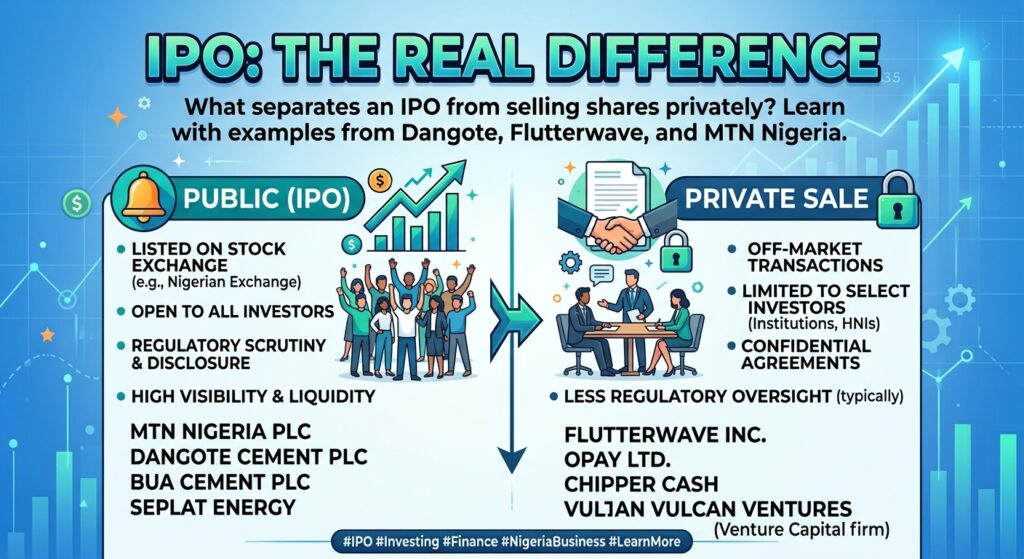
IPO vs Private Shares: What’s the Real Difference?
Every growing business eventually asks the same question: should we raise money from a few private investors, or sell shares to the public through an IPO?
They sound similar. Both involve giving up a piece of ownership for cash. But they are two very different roads, with different rules, different costs, and different consequences for the founder.
This post breaks it down in plain English, with real examples you’ll recognize.
What Is an IPO?
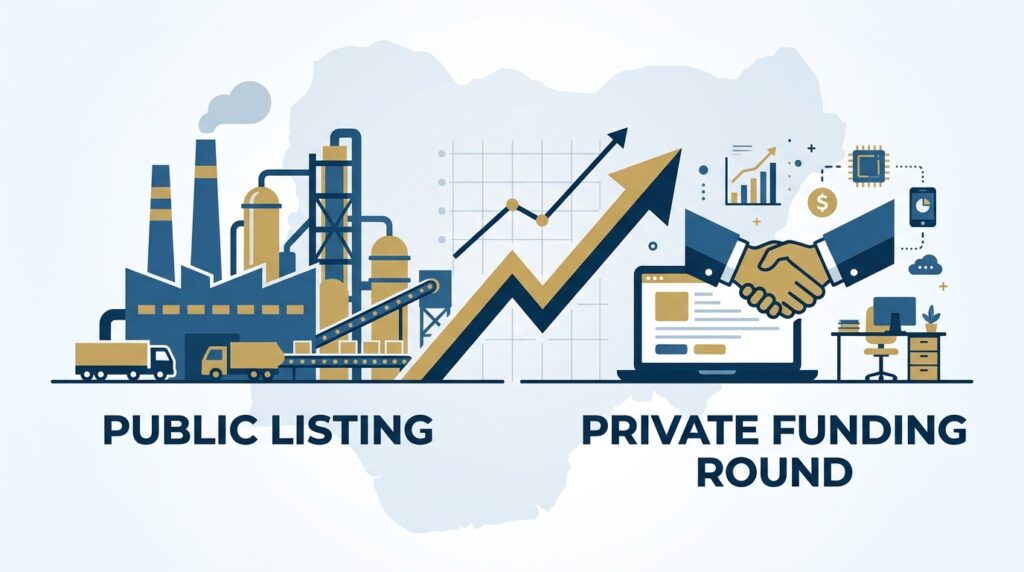
An IPO (Initial Public Offering) is when a company sells its shares to the general public for the first time, through a stock exchange. Anyone — from a market trader in Onitsha to a pension fund in London — can buy in, as long as they go through a licensed stockbroker.
Once the IPO is complete, the company’s shares trade freely on the exchange. The price moves daily based on supply, demand, and news. The company also becomes subject to strict, ongoing disclosure rules: audited financials, public reporting, and constant regulatory oversight.
Real-world example: When Dangote Cement listed on the Nigerian Exchange (NGX), or when the Dangote Group prepared its refinery for an IPO, both went through this exact process — a formal public offer, regulatory approval by the Securities and Exchange Commission Nigeria, a prospectus available to any Nigerian investor, and a listing on the exchange for public trading afterward.
Selling shares privately means the company offers ownership to a small, specific group of investors — not the general public. This includes:
- Private placements to a handful of wealthy individuals or institutions
- Venture capital rounds, where a VC firm buys equity directly
- Angel investment, where an individual funds an early-stage business in exchange for shares
There’s no stock exchange involved. No daily price ticker. No obligation to publish your financials for the world to see. The deal is negotiated privately between the company and the investor.
Real-world example: When Flutterwave raised funding from investors like Tiger Global and Avenida Capital, it wasn’t through an IPO — it was a private funding round. Only the investors involved in that deal got shares; the general public couldn’t buy in even if they wanted to. Nigerian companies like Paystack and Interswitch raised capital the same private way before either ever considered a public listing.
The Core Differences\
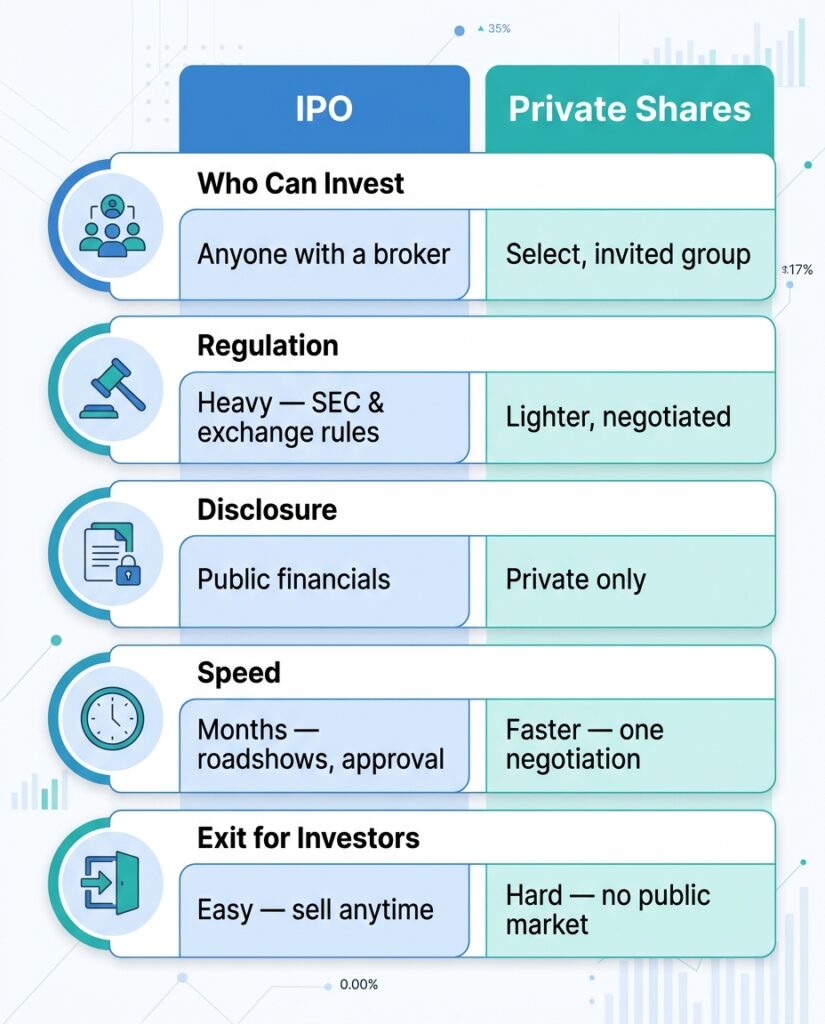
| IPO | Private Shares | |
|---|---|---|
| Who can invest | Anyone with a stockbroker | A select, invited group |
| Regulation | Heavy — SEC and stock exchange rules | Lighter, negotiated privately |
| Disclosure | Public financials, ongoing reporting | Private, only shared with investors |
| Speed | Slow — months of preparation, approval, roadshows | Faster — one negotiation, one signature |
| Cost | High — underwriters, lawyers, auditors, listing fees | Lower — mainly legal and advisory fees |
| Exit for investors | Easy — sell shares on the exchange anytime | Hard — no public market, exit can take years |
| Control | Founder answers to thousands of shareholders | Founder answers to a small, known group |
Why Would a Company Choose One Over the Other?
A company goes the IPO route when it wants:
- Large amounts of capital, often billions of naira, in one raise
- A public profile and brand credibility that comes with being listed
- Liquidity for early investors and founders who want to eventually sell shares easily
A company chooses to sell shares privately when it wants:
- To move fast without the cost and paperwork of a public listing
- To keep its financials and strategy out of public view
- To stay in control with a small group of trusted investors, rather than answer to the wider public
A Nigerian Small Business Angle
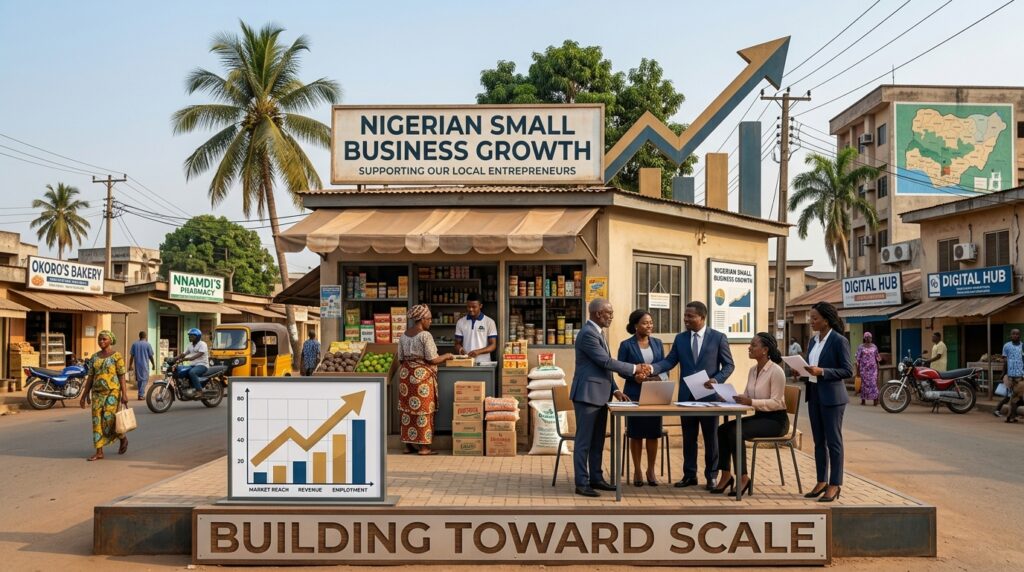
Most Nigerian SMEs will never do an IPO — and that’s completely fine. An IPO only makes sense once a business has scaled to a size where public capital markets are worth the cost and regulatory weight (think Dangote, MTN Nigeria, or Airtel Africa level).
For a growing business in Awka, Onitsha, or Lagos, private shares — through an angel investor, a private equity firm, or a small group of partners — are usually the realistic first step. This is the same stage many property and real estate businesses are in: building trust and structure before scale. If you’re in that world, tools like Mr. Rent show how a small Nigerian business can grow a credible, scam-free platform — property search, verified listings, and secure transactions — long before an IPO is even a conversation. Some businesses grow big enough for an IPO to eventually make sense. Most don’t need to, and many stay successful and profitable without ever going public.
If you want to go deeper on how capital markets and business fundamentals work, our sister platform Faster Aim breaks down these concepts in full courses, and Faster Aim – SBGF covers how stories like the Dangote IPO are unfolding in real time.
The Bottom Line
An IPO opens your company to the entire investing public, with all the capital, scrutiny, and cost that comes with it. Selling shares privately keeps things smaller, faster, and more controlled — but caps how much you can raise and who can invest.
Neither option is “better.” The right choice depends on how much capital you need, how fast you need it, and how much public exposure your business is ready for.
Next in this series: [Underwriters Explained — Why Big IPOs Rarely Fail]
Leave a Reply