5 institutions to get loan to fund business
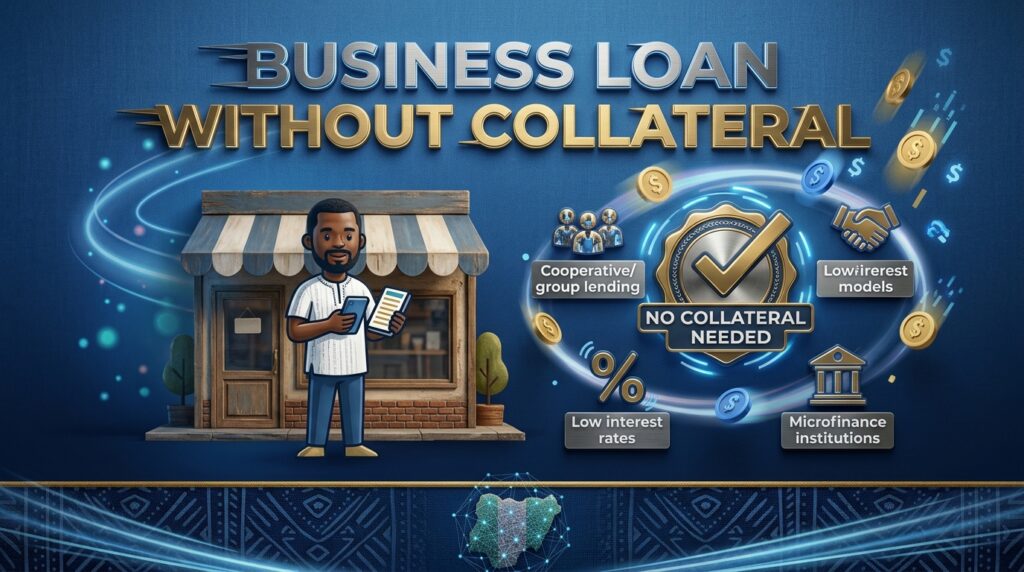
Ask most Nigerian banks for a business loan, and the first question is almost always the same: “What’s your collateral?” Land. A car. Property papers. For most small business owners — traders, tailors, food vendors, online sellers — that single question ends the conversation before it starts.
But it doesn’t have to. In 2026, there are several genuine, collateral-free ways to fund a small business in Nigeria. This post breaks down exactly where to look, what each option actually offers, and how to qualify.
Why Collateral Shouldn’t Stop You
Traditional commercial banks — Access Bank, Zenith, GTBank, UBA, First Bank — still dominate business lending in Nigeria, but their loan products typically require collateral and charge 18–30% annual interest. That works for an established company with fixed assets. It doesn’t work for a small trader in Onitsha market or a first-time online seller with no property to pledge.
The good news: government-backed development finance institutions, cooperative societies, and group-lending programs were built specifically to close this gap.
1. NIRSAL Microfinance Bank — The Most Accessible Option
NIRSAL Microfinance Bank (NMFB) is one of the most collateral-friendly lenders operating in Nigeria today, with several products built around no traditional collateral:
- AGSMEIS Loan — up to ₦3 million for SMEs and agribusinesses, charged at just 9% annual interest through the CBN-backed AGSMEIS initiative, with alternative arrangements like business assets or group guarantees accepted instead of property titles
- Amazon Loan — specifically for women entrepreneurs, ₦50,000 to ₦1,000,000, with zero collateral required when a group of 5 to 10 women in the same business sector and location apply together
- OBSL Petty Cash Loan — working capital for traders and craftsmen, built around cash flow rather than assets
You can check current products directly on NIRSAL Microfinance Bank’s official site.
2. Bank of Industry (BOI)
The Bank of Industry remains Nigeria’s leading development finance institution for structured SMEs. Its MSME funds are aimed at businesses with a registered structure and a clear growth sector — agribusiness, manufacturing, ICT, and the creative sector all qualify — and typically ask for reduced or no traditional collateral compared to commercial banks, though applicants usually need business registration, a valid BVN, and in some cases mandatory training before disbursement.
3. Cooperative Societies
This is the option most overlooked by first-time borrowers, and often the fastest. A cooperative society pools savings from its members and lends back to them based on trust and savings history — not property.
A trader who saves consistently in a cooperative can typically access a loan worth several multiples of what they’ve saved, with no land or vehicle papers required. If you’re not already part of a trade association or market cooperative in Awka or Onitsha, this is one of the simplest doors to open.
4. CBN-Backed Group Programs (TraderMoni / MarketMoni)
Government-backed micro-lending schemes like TraderMoni and MarketMoni were designed for petty traders and market women, offering small, collateral-free loans that grow in size as repayment history builds. The amounts start modest, but they’re a realistic entry point for someone with no formal credit history at all.
5. Digital Lenders — Use With Caution
Fintech lenders like Carbon, FairMoney, and Renmoney can disburse a loan within 24–48 hours with no collateral, based mostly on your transaction history and BVN data. They’re fast, but the trade-off is real: effective interest rates run considerably higher than government-backed options. These are best used for short-term working capital gaps, not as your primary growth financing.
Also Read: Secret of great wealth swept under your feet
Comparing Your Options
| Source | Collateral Needed | Typical Rate | Best For |
|---|---|---|---|
| NIRSAL AGSMEIS | None — alternative arrangements accepted | ~9% annually | Registered SMEs, agribusiness |
| NIRSAL Amazon Loan | None (group of 5–10 women) | Low, subsidized | Women-led small businesses |
| Bank of Industry | Reduced/none for eligible sectors | Low, structured | Growth-stage, registered SMEs |
| Cooperative Society | None — based on savings history | Low to moderate | Traders, market women |
| TraderMoni/MarketMoni | None | Minimal/subsidized | First-time, micro-scale borrowers |
| Digital Lenders (Carbon, FairMoney) | None | High | Short-term cash flow gaps |
What Increases Your Chances of Approval
Regardless of which route you choose, a few things consistently improve your odds:
- Register your business with CAC — even a simple Business Name registration signals legitimacy
- Keep clean transaction records — banks and fintech lenders both check BVN-linked transaction history
- Build a savings or cooperative track record before you need the loan, not after
- Match the loan amount to your actual cash flow — over-borrowing is the most common reason repayment breaks down
A Word on Building Toward Bigger Capital
A collateral-free loan is often just the first rung. As we covered in our IPO vs Private Shares post, most Nigerian businesses that eventually raise serious capital — whether through private investors or, much later, a public listing — start exactly here: small, disciplined borrowing that builds a track record. Platforms like Mr. Rent are a good example of a Nigerian business built the same way — starting lean, building trust and verified operations, long before needing large external capital.
If you’re figuring out where your business fits in that bigger picture, Faster Aim has courses that walk through business fundamentals in more depth, and Faster Aim News regularly covers new government funding announcements as they happen.
The Bottom Line
Not having land or property papers doesn’t mean you can’t fund your business. NIRSAL Microfinance Bank, the Bank of Industry, cooperative societies, and CBN-backed group programs were all built precisely for small business owners without traditional collateral. Start with the option that matches your business size and documentation today, build a repayment record, and larger capital options open up from there.
Next in this series: Underwriters Explained — Why Big IPOs Rarely Fail
Leave a Reply