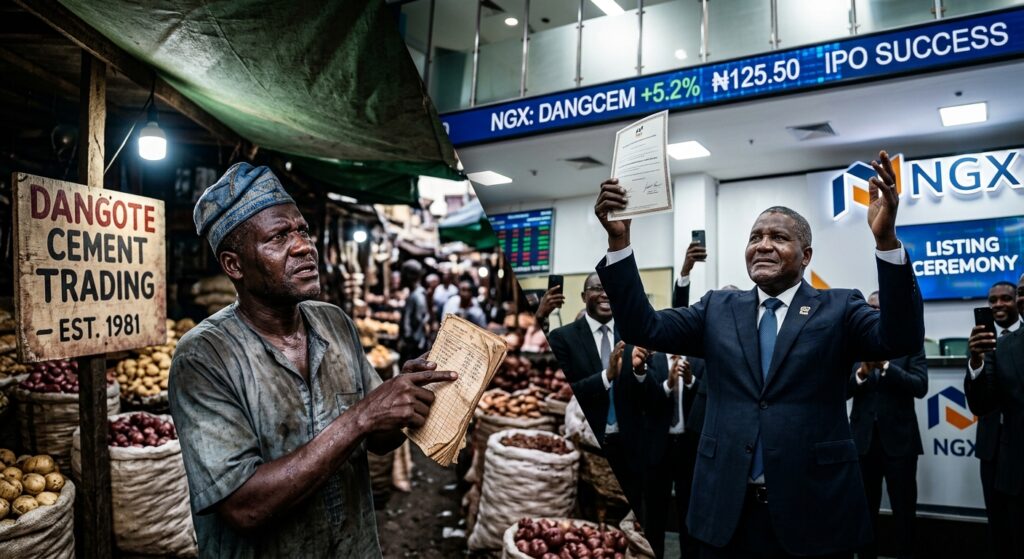
From Local Shop to Public Company: What It Really Takes to Go Public in Nigeria
To host an Initial Public Offering (IPO) and list equity on the Nigerian Exchange (NGX), a company must satisfy rigorous legal, structural, financial, and governance standards. The process is overseen jointly by the Securities and Exchange Commission (SEC)—which acts as the capital market regulator—and the NGX, which operates the trading platform.
Qualification depends heavily on which of the NGX’s distinct board tiers the company targets.
Universal Legal & Statutory Requirements
Before applying to any specific board, every candidate must meet core legal prerequisites:
- Legal Entity Structure: The business must be incorporated as a Public Limited Company (Plc) under Nigeria’s Companies and Allied Matters Act (CAMA). Private limited companies (Ltd) cannot issue shares to the public without first executing a re-registration and conversion process.
- Accounting Standards: Financials must strictly comply with International Financial Reporting Standards (IFRS). Accounts must be audited by an independent auditing firm registered with the SEC and the Financial Reporting Council of Nigeria (FRCN).
- SEC Registration: The company must register its securities with the SEC and submit an exhaustive prospectus detailing capital structure, historic operational metrics, litigation exposure, risk factors, and the intended use of proceeds.
- Lock-Up Commitments: Promoters and core directors are required to hold onto at least 50% of their pre-IPO shareholding for a minimum of 12 months following the listing date to prevent immediate capital flight.
Specific Entry Criteria by NGX Board
1. Growth Board (SMEs & High-Growth Scale-Ups)
The Growth Board features a lighter regulatory burden designed to give emerging companies, technology startups, and mid-sized enterprises access to public capital.
- Segment Division: Split into a Entry Segment for early-stage firms and a Standard Segment for emerging mid-caps.
- Market Capitalization: Minimum ₦50 Million for the Entry Segment; minimum ₦500 Million for the Standard Segment.
- Operational History: At least 2 years of active business operations for the Entry Segment, or 3 years for the Standard Segment.
- Financial Audits: Minimum of 2 years of audited financial statements, with the date of the last audited accounts not older than 9 months at submission.
- Profitability: Pre-tax profit track record is not mandatory, provided the company can demonstrate strong growth trajectory and viable commercial projections.
- Public Float (Liquidity): At least 10% of each class of equity must be held by public investors (or 15% under the Standard Segment).
- Public Shareholder Base: Minimum of 21 public shareholders for Entry; minimum of 51 for Standard.
- Mandatory Retainers: Must appoint and retain an NGX-approved Designated Adviser continuously to assist with ongoing regulatory disclosures.
2. Main Board (Established Commercial Enterprises)
The Main Board targets mature companies with proven track records seeking substantial liquidity.
- Track Record Options: Companies can qualify via different listing standards depending on profitability versus asset size:
- Standard A (Profitability Route): Minimum 3-year operating history with a cumulative pre-tax profit of at least ₦300 Million over the preceding 3 years, with at least ₦100 Million earned in two of those years.
- Standard B (Market Value/Asset Route): For companies with high asset backing or capital requirements that do not yet meet the profit threshold, market capitalization at listing must be at least ₦4 Billion.
- Financial History: 3 consecutive years of audited financial statements prepared under IFRS.
- Public Float: At least 20% of issued share capital must be held by the public, or the value of the public float must equal or exceed ₦40 Billion on the date the application is received.
- Public Shareholder Base: Minimum of 300 public equity shareholders.
Reserved for large-cap institutions that demonstrate exceptional operational scale and adhere to global governance practices.
- Market Capitalization: Minimum of ₦200 Billion at the date of application.
- Operational Track Record: Minimum 3 years of proven operating history and financial records.
- Governance Rating: Must score at least 70% under the NGX Corporate Governance Rating System (CGRS), a rigorous audit evaluating board independence, transparency, and ethics.
- Public Float: Minimum 20% of issued equity held by the public, OR a free float valuation equal to or exceeding ₦40 Billion.
- Public Shareholder Base: Minimum of 300 public shareholders.
The Required Professional Transaction Team
A company cannot execute an IPO independently. SEC regulations require the issuer to retain a team of licensed capital market operators:
Registrars: Entities managing shareholder registers, share allocations, CSCS account creditings, and dividend distribution mechanics.
Issuing House / Lead Manager: Investment bankers who structure the offer price, handle financial modeling, compile the prospectus, and manage regulatory filings with the SEC and NGX.
Reporting Accountants: An independent accounting firm (separate from statutory auditors) that prepares the Long-Form Report, investigating historical accounts and financial forecasts.
Solicitors to the Issue: Legal counsel responsible for corporate due diligence, verified asset ownership, verification of legal risks, and verifying prospectus compliance.
Stockbrokers to the Issue: Licensed market operators responsible for sponsored listing applications on the trading floor and marketing the offering to institutional and retail brokerages.
#ipo, #Dangoteipo ipo_Nigeria, public_ipo, ipoDiaspora
Still building toward that stage? Explore more guides on formalizing and growing a Nigerian business at smallbusiness.fasteraim.com.
Leave a Reply