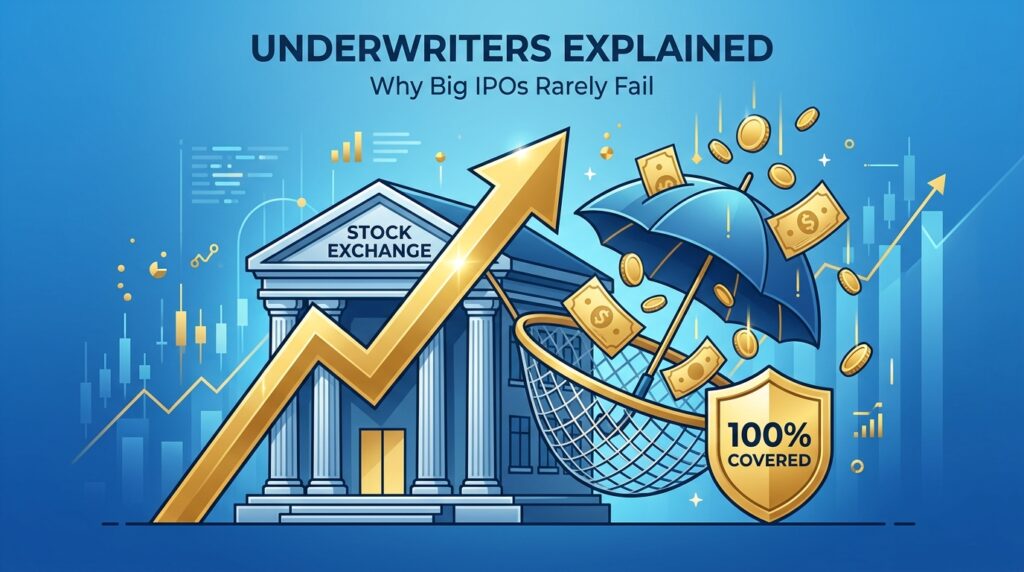
Underwriters Explained: Why Big IPOs Rarely Fail
Every time a major company announces a huge IPO, someone in the comments says the same thing: “This is overhyped, it will flop.” In practice, that almost never happens — and the reason has a name: the underwriter.
This post explains exactly what an underwriter does, why big IPOs rarely fail because of one, and how the process actually played out in real Nigerian listings.
What Does an Underwriter Actually Do?
An underwriter — usually an investment bank or a group of them — agrees, before an IPO opens to the public, to buy up any shares that investors don’t subscribe to. In exchange, the company pays the underwriter a fee, usually a percentage of the total offer size.
In plain terms: the company is guaranteed to sell its shares one way or another. Either the public buys them, or the underwriter does. That guarantee is what protects a large IPO from technically “failing” — even if public demand comes in lower than hoped.
A Simple Example
Imagine a company wants to sell 1 billion shares to the public. If only 700 million shares get bought by investors, the remaining 300 million don’t just sit unsold — the underwriter, under the terms agreed before the offer opened, steps in and buys them instead, at the same price. The company still receives its full expected proceeds.
This is exactly why, whenever you see a company running a large marketing campaign around an IPO, it doesn’t necessarily mean they’re desperate — a lot of that work is happening precisely because so much preparation, structuring, and underwriting has already gone in behind the scenes.
Real-World Example: Dangote’s $400 Million Underwriting Commitment

When Dangote Refinery prepared its planned public offering, it secured a large underwriting programme — including a $400 million commitment specifically dedicated to underwriting the IPO, on top of a separate $600 million tranche tied to its earlier private placement. That commitment meant that even if public subscription came in below the full offer size, a large portion of any shortfall was already covered before the offer ever opened to Nigerian investors.
This is the exact mechanism that makes headlines like “Dangote IPO will definitely succeed” more grounded than they might sound at first — not because hype guarantees success, but because structured financial backing does.
Real-World Example: MTN Nigeria’s Different Route
Not every major Nigerian listing needs a traditional underwriter, and MTN Nigeria’s 2019 listing is a useful contrast. Rather than a fully underwritten public offer raising new capital, MTN Nigeria listed on the Nigerian Exchange largely through an introduction — existing shares held by current shareholders were simply admitted to trade on the exchange, without the same public subscription and underwriting structure a fresh capital-raising IPO requires. Advisers like Chapel Hill Denham, Stanbic IBTC Capital, and Citigroup managed the process, but the “will it undersell” risk that underwriting protects against wasn’t the same concern, since new shares weren’t being sold to raise fresh public capital in that phase.
This distinction matters: not every “listing” is the same kind of IPO, and not every listing needs the same underwriting protection.
Why Underwriters Take the Risk
An underwriter doesn’t do this for free or out of goodwill — it’s a calculated business decision:
- They earn a fee (commonly a percentage of total funds raised) regardless of how the offer performs
- They’ve typically done deep due diligence on the company beforehand, so they have a reasonable sense the shares will sell
- If they do end up holding unsold shares, they can usually sell them later once the shares are trading, rather than holding them indefinitely
What This Means If You’re Considering Investing
Next time you see a large IPO with heavy marketing, don’t just ask “will the price go up?” Ask:
- Is there a named underwriter or underwriting commitment behind this offer?
- What portion of the raise is actually covered?
- Is this a capital-raising public offer, or an introduction like MTN Nigeria’s, where different rules apply?
Understanding this one mechanism explains a lot of what looks like confidence — or hype — around big listings.
A Nigerian Small Business Angle
Most Nigerian small businesses will never need an underwriter — that’s a tool for large, capital-market-level offers, not the private funding rounds most SMEs use. If you’re earlier in that journey, our IPO vs Private Shares post breaks down which route actually fits a growing business, and our business loan without collateral post covers realistic funding options long before anything like underwriting becomes relevant. Businesses like Mr. Rent show what that earlier, still-private stage of growth looks like in practice.
To go deeper on capital markets fundamentals, Faster Aim has courses covering this in more depth, and Faster Aim News tracks how ongoing IPO stories like Dangote’s are unfolding.
The Bottom Line
An underwriter is the safety net behind most large IPOs — a paid commitment to buy whatever the public doesn’t, which is exactly why big, well-structured offers rarely “fail” in the way people assume. Not every listing uses one the same way, as MTN Nigeria’s introduction shows, but where one exists, it’s usually the strongest signal that a company’s IPO is built to succeed regardless of how public demand comes in on day one.
Next in this series: From Local Shop to Public Company — What It Really Takes to Go Public in Nigeria
Leave a Reply